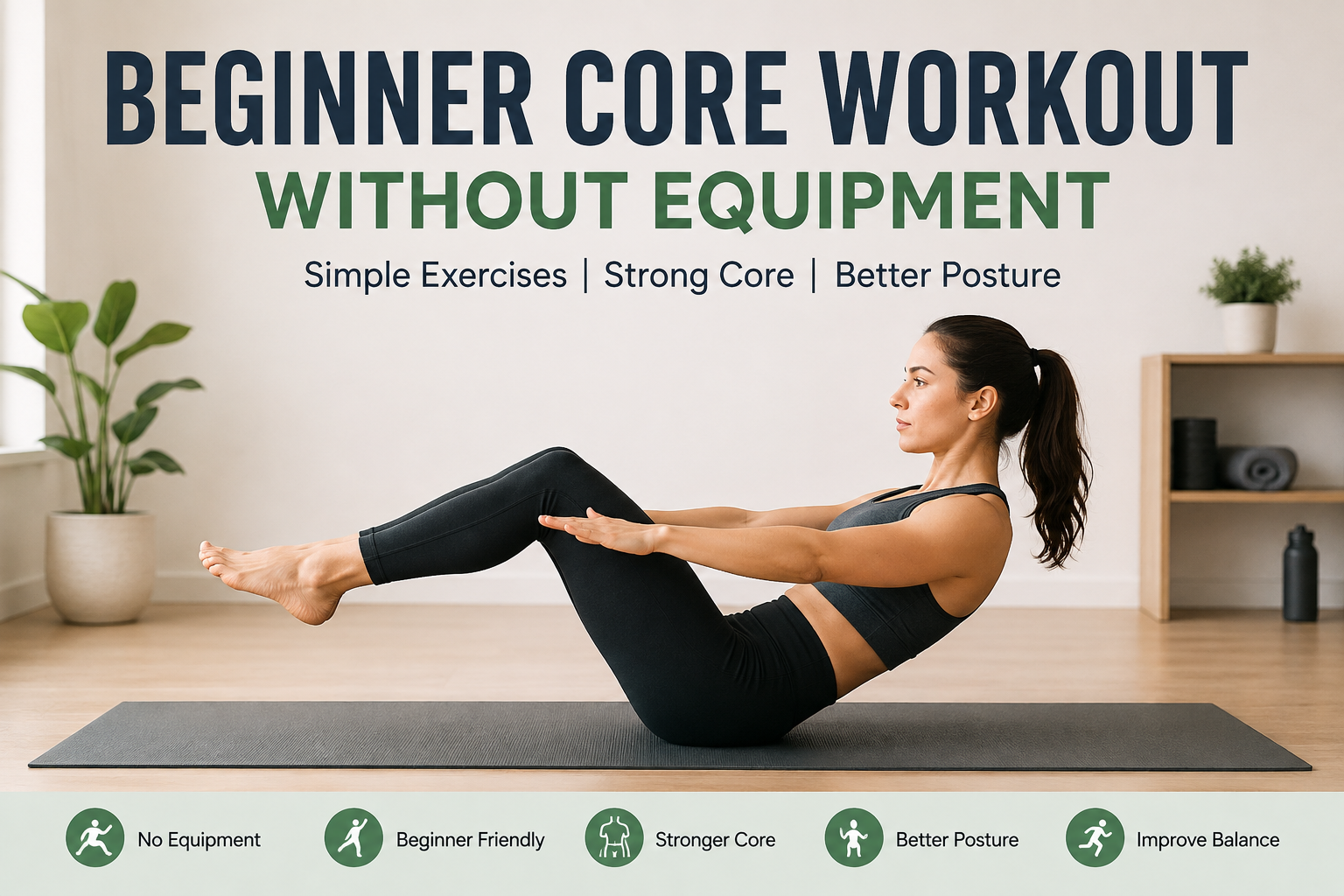
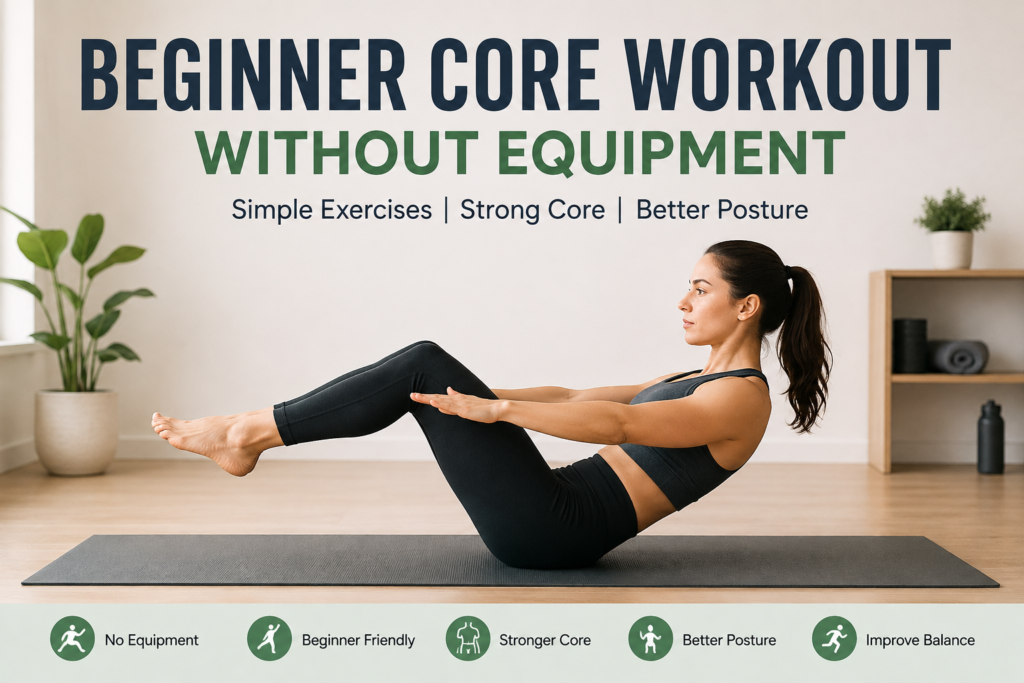
A strong core is one of the most useful parts of overall fitness. In my experience, you do not need a gym membership, expensive machines, or heavy weights to start strengthening your core. A simple beginner core workout without equipment can be done at home with enough space and a little consistency.
Many people think core training is only about getting visible abs, but I believe there is much more to it. Your core helps support your body during everyday movements such as walking, bending, lifting, sitting, and climbing stairs. A stronger core can also help you maintain better posture and feel more stable during other exercises.
If you are new to exercise, starting with simple bodyweight movements is a good option. The exercises in this guide are designed for beginners and require no special equipment.
What Is a Core Workout?
The core is more than just your stomach muscles. It includes several muscles around your abdomen, lower back, hips, and pelvis. These muscles work together to help stabilize your body.
A beginner core workout focuses on controlled movements that train these muscles without requiring complicated equipment. Exercises such as planks, dead bugs, bird dogs, and glute bridges can be performed using only your body weight.
When I recommend core exercises to beginners, I usually focus on proper form rather than trying to complete as many repetitions as possible. Good technique helps you get more from each movement and makes your workout easier to manage.
Benefits of a Beginner Core Workout Without Equipment
One of the biggest advantages of bodyweight core exercises is convenience. You can exercise in your bedroom, living room, or another comfortable space at home.
A consistent core workout may help improve your balance, stability, posture, and movement control. A stronger core can also make other activities feel easier because your body has a more stable center.
Another benefit is that you can adjust most exercises according to your fitness level. You can begin with shorter workout sessions and gradually increase the time or repetitions as you become more comfortable.
1. Dead Bug
The dead bug is one of my favorite beginner core exercises because it teaches you how to control your abdominal muscles while moving your arms and legs.
Start by lying on your back with your knees bent and lifted. Keep your arms pointed toward the ceiling. Slowly extend one leg while moving the opposite arm toward the floor. Return to the starting position and repeat on the other side.
Try to keep your lower back gently connected to the floor throughout the movement.
Start with 6 to 10 repetitions on each side. Move slowly rather than rushing through the exercise.
2. Forearm Plank
The forearm plank is a simple exercise that can challenge several muscles at the same time.
Begin by placing your forearms on the floor and extending your legs behind you. Keep your body in a straight line from your shoulders to your heels. Tighten your abdominal muscles and avoid letting your hips drop toward the floor.
If a full plank feels difficult, place your knees on the floor while keeping your upper body controlled.
For beginners, holding the position for 15 to 30 seconds is enough. As your core becomes stronger, you can gradually increase the duration.
3. Bird Dog
Bird dog is another excellent bodyweight exercise for beginners. It works your core while also challenging your balance and coordination.
Start on your hands and knees. Keep your back in a comfortable neutral position. Slowly extend your right arm and left leg. Hold for a moment, then return to the starting position.
Repeat the movement using your left arm and right leg.
Try 6 to 10 repetitions on each side. Focus on keeping your hips steady instead of allowing your body to rotate.
4. Glute Bridge
Although the glute bridge is often considered a lower body exercise, it is also useful for a beginner core workout.
Lie on your back with your knees bent and your feet flat on the floor. Keep your arms beside your body. Press through your feet and lift your hips until your body forms a comfortable line from your shoulders toward your knees.
Squeeze your glutes at the top and slowly lower your hips.
Start with 10 to 15 repetitions. Keep the movement controlled and avoid using momentum.
5. Heel Taps
Heel taps are simple and beginner friendly. They can be useful when you want to add more movement to your abdominal workout.
Lie on your back with your knees bent and feet flat on the floor. Lift your shoulders slightly if comfortable. Reach one hand toward the same side heel, then return to the center and reach toward the opposite heel.
Keep the movement small and controlled.
Perform 10 to 15 repetitions on each side. If you feel strain in your neck, lower your shoulders and focus on maintaining relaxed breathing.
6. Glute Bridge March
Once you feel comfortable with regular glute bridges, you can try a bridge march.
Start in the same position as a normal glute bridge. Lift your hips and keep them stable. Slowly lift one foot slightly from the floor and return it. Then repeat on the other side.
The goal is to prevent your hips from moving excessively.
Start with 6 to 8 repetitions on each side. If you cannot keep good control, return to regular glute bridges.
7. Modified Side Plank
The modified side plank is a useful exercise for training the muscles along the sides of your core.
Lie on one side and support your upper body with your forearm. Keep your knees bent. Lift your hips gently from the floor while keeping your body controlled.
Hold the position for about 10 to 20 seconds, then switch sides.
As you become stronger, you can gradually increase the holding time.
A Simple Beginner Core Workout Routine
If you are wondering how to put these exercises together, you can start with a short routine.
Begin with dead bugs for 8 repetitions on each side. Follow them with a forearm plank for 20 seconds. Then perform bird dogs for 8 repetitions on each side.
After that, complete 12 glute bridges and 10 heel taps on each side. Finish with a modified side plank for 15 seconds on each side.
Rest for about 30 to 60 seconds between exercises if needed.
You can complete one round when you are just starting. After a few weeks of consistent training, you may feel ready to complete two or three rounds.
How Often Should Beginners Train Their Core?
You do not need to train your core every day. I prefer a balanced approach because your muscles also need time to recover.
For most beginners, two or three core workouts per week can be a practical starting point. You can combine your core exercises with walking, bodyweight strength exercises, stretching, or other forms of physical activity.
Consistency is more important than doing an extremely difficult workout once and then stopping for several weeks.
Common Mistakes to Avoid
One common mistake is trying to exercise too quickly. Core exercises are usually more effective when performed with slow and controlled movements.
Another mistake is holding your breath. Try to breathe naturally throughout your workout. Exhale during the more challenging part of a movement and inhale as you return to the starting position.
Poor posture is another issue beginners should watch for. For example, during a plank, avoid allowing your lower back to sag. During exercises performed on your back, focus on keeping your body stable.
It is also important not to compare your progress with someone else’s. Everyone starts from a different fitness level.
How to Make Core Exercises More Challenging
Once these exercises become easier, you can increase the challenge gradually.
You can add a few repetitions, increase plank holding time, or perform movements more slowly. You can also add another round to your workout.
I recommend changing only one thing at a time. There is no need to make your workout dramatically harder every week.
The goal is steady progress while maintaining proper technique.
Tips for Better Results
If you want to get better results from a beginner core workout without equipment, pay attention to the basics.
First, stay consistent. A short workout performed regularly is more useful than an intense session that you rarely repeat.
Second, focus on technique. You should feel that your core is working, but you should not ignore pain or discomfort.
Third, combine core training with a generally active lifestyle. Walking, stretching, strength training, and other enjoyable activities can complement your core workouts.
Finally, give your body enough rest. Sleep, nutrition, hydration, and recovery all play an important role in your fitness progress.
Is a Core Workout Enough for Overall Fitness?
A core workout is useful, but it should not be your only form of exercise. Your body benefits from a combination of strength, cardiovascular activity, mobility, and everyday movement.
If you are a beginner, you can start with a simple weekly routine that includes walking, basic bodyweight exercises, and two or three core sessions.
This approach can be much easier to maintain than trying to follow an extremely demanding workout program.
Final Thoughts
A beginner core workout without equipment is a simple way to start building strength and stability at home. You do not need expensive fitness equipment or complicated exercises. Your own body weight can provide enough resistance for many beginner movements.
In my opinion, the most important thing is to start at a level that feels manageable and improve gradually. Exercises such as dead bugs, planks, bird dogs, glute bridges, heel taps, and modified side planks can give beginners a practical foundation.
Remember that progress takes time. Focus on good form, regular practice, proper recovery, and realistic goals. With consistency, your core can become stronger and your everyday movements may feel more controlled and comfortable.
If you experience pain while exercising, stop the movement and consider speaking with a qualified healthcare or fitness professional before continuing.