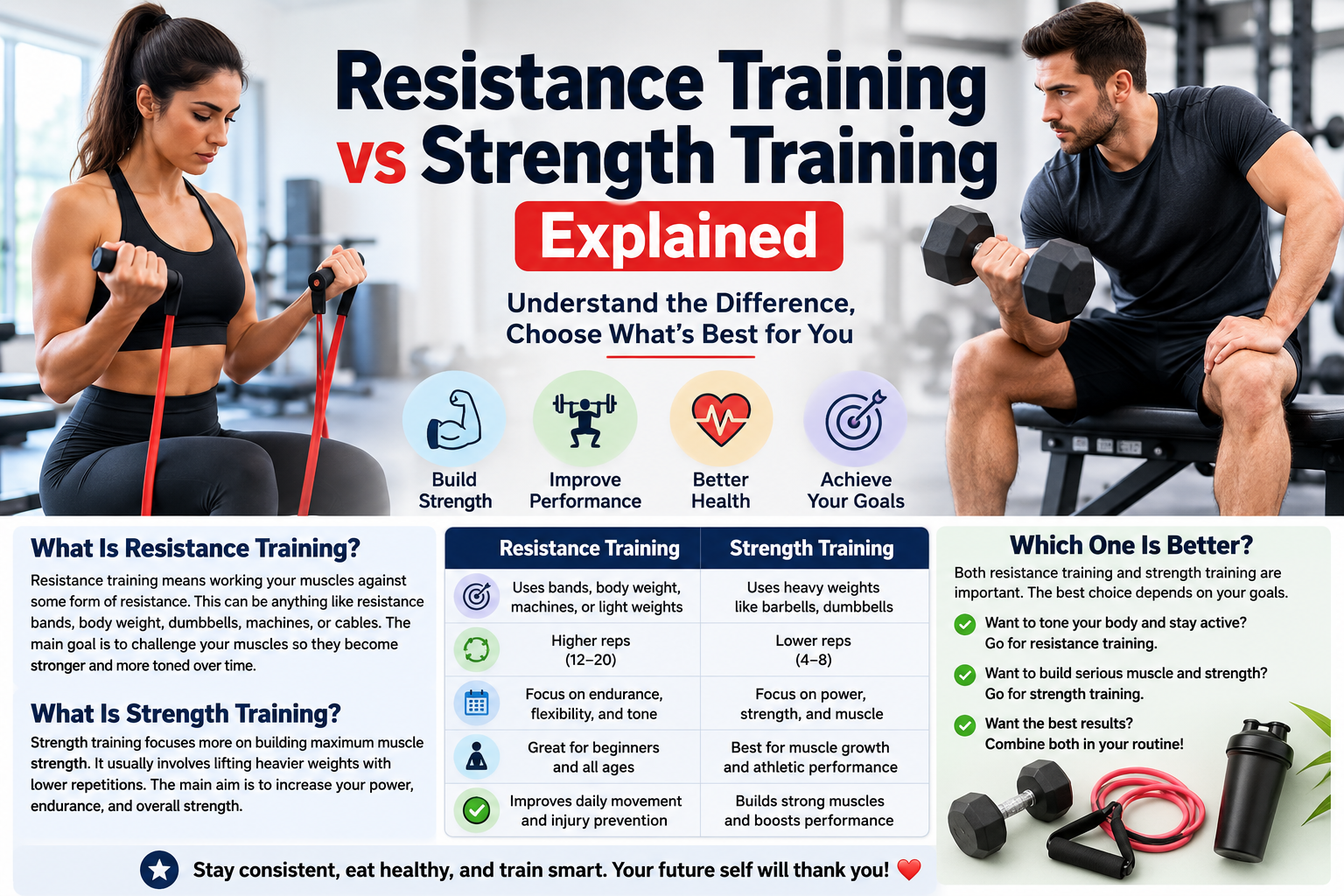
When I first started learning about fitness, I often heard the terms resistance training and strength training. At first, I thought they were exactly the same thing. After learning more about exercise and trying different workouts, I realized that there is a small but important difference between them.
Both types of training can help improve physical fitness, build muscle, support healthy movement, and make everyday activities easier. However, they do not always have the same primary goal. In this article, I will explain resistance training vs strength training in simple words and share what I have learned about choosing the right approach.
What Is Resistance Training?
Resistance training is a broad type of exercise where your muscles work against some form of resistance. The resistance can come from your body weight, resistance bands, dumbbells, barbells, cables, machines, or other equipment.
The main idea is simple. Your muscles have to work harder than they normally would, which encourages them to adapt over time.
For example, when you perform a bodyweight squat, your legs work against the resistance created by your body weight and gravity. When you use a resistance band for a row, your back and arm muscles work against the tension of the band.
This is why resistance training can be done in many different ways. You do not necessarily need a large gym or expensive equipment to get started.
What Is Strength Training?
Strength training is generally considered a type of resistance training that focuses specifically on improving how much force your muscles can produce.
For example, someone who regularly practices squats with gradually increasing weights may be training to become stronger. A person practicing heavier deadlifts or bench presses with proper technique is also likely focusing on strength development.
Strength training often involves heavier resistance, controlled movements, and fewer repetitions compared with some other forms of resistance exercise. However, the exact number of repetitions and amount of weight can vary depending on the person and their training goals.
In simple terms, I like to think about it this way: resistance training is the larger category, while strength training is one specific goal within that category.
Resistance Training vs Strength Training: The Main Difference
The easiest way to understand the difference is to look at the main purpose.
Resistance training can focus on several goals, including muscle endurance, muscle development, general fitness, movement quality, and strength.
Strength training has a more specific focus. The main goal is to increase strength and improve the ability to produce force.
For example, doing bodyweight lunges for several repetitions can be resistance training. Training to increase the amount of weight you can safely lift in a squat is more specifically strength training.
There is plenty of overlap between the two. A resistance workout can make you stronger, and strength training is still resistance training.
Types of Resistance Training
One thing I like about resistance training is how flexible it can be. There are several ways to add resistance to an exercise routine.
Bodyweight Training
Bodyweight exercises use your own body as resistance. Push ups, squats, lunges, planks, and step ups are common examples.
This is a convenient option for beginners because you can perform many exercises at home without buying equipment.
Resistance Bands
Resistance bands are another useful option. They are lightweight, easy to store, and can be used for exercises such as rows, chest presses, shoulder exercises, squats, and leg movements.
I think resistance bands are especially useful for people who want a simple home workout.
Free Weights
Dumbbells, barbells, and kettlebells are examples of free weights. They allow you to increase resistance gradually and perform a wide range of exercises.
Free weights are commonly used in both general resistance workouts and dedicated strength training programs.
Weight Machines
Gym machines provide another form of resistance. They can help guide the movement and allow you to target particular muscle groups.
For beginners, machines can sometimes feel easier to understand because the movement path is more controlled.
Benefits of Resistance Training
Resistance training offers several benefits when it is performed consistently and with good technique.
One major benefit is stronger muscles. Your muscles adapt to the challenge placed on them, which can improve your ability to perform physical tasks.
Resistance training can also support bone health and help maintain muscle as you get older. Strong muscles can make everyday movements such as climbing stairs, carrying groceries, and getting up from a chair feel easier.
Another benefit is improved muscular endurance. If you regularly perform exercises for several repetitions, your muscles may become better at working for longer periods.
Resistance training can also support body composition goals when combined with a balanced diet and an active lifestyle.
Personally, I think one of its biggest advantages is flexibility. You can create a resistance workout based on your fitness level, available equipment, schedule, and personal goals.
Benefits of Strength Training
Strength training has many of the same benefits but places greater emphasis on increasing physical strength.
One of the most obvious benefits is improved lifting ability. With consistent training, you may become capable of handling heavier resistance with proper technique.
Strength training can also support muscle development. When muscles are challenged progressively, they can adapt and become stronger and, depending on training and nutrition, larger.
Another important benefit is improved physical performance. Stronger muscles can help with sports, recreational activities, and everyday movements.
Strength training may also improve confidence. I have found that being able to perform an exercise more comfortably or gradually increase the resistance can make a workout routine feel rewarding.
Which Is Better for Beginners?
For most beginners, I would not worry too much about choosing between resistance training and strength training at the beginning.
Instead, I would focus on learning basic movement patterns and developing good exercise habits.
Bodyweight squats, modified push ups, rows with a resistance band, glute bridges, and light dumbbell exercises can provide a good starting point.
The goal should not be to lift the heaviest possible weight immediately. Learning proper form and controlling each movement is much more important.
As you become more comfortable, you can gradually increase the challenge.
Which Is Better for Building Muscle?
Both resistance training and strength training can help build muscle.
Muscle growth depends on several factors, including training volume, resistance, exercise selection, recovery, nutrition, and consistency.
Someone can build muscle using dumbbells, machines, resistance bands, or bodyweight exercises. The important thing is that the muscles receive an appropriate challenge and the training progresses over time.
If your main goal is muscle development, I would focus on a well planned resistance training routine rather than thinking that only very heavy strength training can build muscle.
Which Is Better for Getting Stronger?
If your main goal is to increase maximum strength, a dedicated strength training approach may be more suitable.
Strength focused programs often use challenging resistance and carefully planned progression. Exercises such as squats, deadlifts, presses, and rows can be included depending on your goals and experience.
However, you do not need to start with heavy weights. Strength is developed gradually.
I believe beginners should first build a foundation with manageable resistance and good technique before worrying about lifting very heavy weights.
Can You Combine Resistance Training and Strength Training?
Yes, and this is something I personally prefer.
There is no rule saying you have to choose only one. A balanced fitness routine can include different forms of resistance training while also giving you opportunities to improve strength.
For example, you could perform strength focused exercises with weights while also using resistance bands and bodyweight movements.
This approach can make workouts more interesting and allow you to work on different aspects of fitness.
You can also adjust your workouts based on your goals. If strength is your biggest priority, you can give more attention to strength focused exercises. If general fitness is your priority, you can include a wider variety of resistance exercises.
How Often Should You Train?
The right training frequency depends on your fitness level, goals, schedule, and recovery.
A beginner does not need to train intensely every day. Starting with a manageable routine can make it easier to stay consistent.
For example, full body resistance workouts several times per week can be a practical starting point for many people.
Rest and recovery are also important. Your muscles need time to recover from training, especially when the workouts are challenging.
I have learned that consistency is usually more valuable than trying to do too much too quickly.
Common Mistakes to Avoid
One common mistake is increasing the weight too quickly. More weight does not automatically mean a better workout. If your technique becomes poor, you may reduce the quality of the exercise and increase your risk of injury.
Another mistake is ignoring recovery. Training hard without allowing enough recovery can make it difficult to maintain a routine.
Some people also focus only on one exercise or muscle group. A balanced routine should include different movement patterns and muscle groups.
Finally, do not compare your progress with someone else. Everyone starts at a different fitness level.
Resistance Training vs Strength Training: Which One Should You Choose?
The answer depends on your personal goal.
If you want general fitness, better muscular endurance, stronger muscles, and a flexible workout routine, resistance training is a great choice.
If your main goal is becoming significantly stronger and improving your ability to lift heavier resistance, strength training may be more appropriate.
For many people, however, the best approach is a combination of both.
You can use resistance bands, bodyweight exercises, machines, and free weights while gradually developing strength.
Final Thoughts
Resistance training vs strength training is not really a competition. Strength training is part of the larger world of resistance training, and both can play an important role in a healthy fitness routine.
From my point of view, the best workout is the one that matches your goals and that you can perform consistently. You do not need complicated equipment or an advanced program to begin.
Start with exercises you can perform safely, learn proper technique, increase the challenge gradually, and give your body enough time to recover.
Whether you choose bodyweight exercises, resistance bands, dumbbells, machines, or heavier weights, consistency matters most. With patience and regular practice, resistance training and strength training can both help you become stronger, fitter, and more confident in your daily life.
Note: If you are new to exercise or have an existing health concern, consider speaking with a qualified fitness professional or healthcare professional before starting a new training program.