Starting a workout routine can feel difficult when you think you need a gym, expensive equipment, or a complicated training plan. In my experience, this is one of the biggest reasons beginners delay getting started. The good news is that you can build a strong foundation with simple bodyweight exercises that use your own body for resistance.
Bodyweight exercises are easy to learn, require little or no equipment, and can be performed at home, outdoors, or almost anywhere. They can help improve strength, balance, flexibility, endurance, and general fitness. For beginners, the main goal should not be doing as many repetitions as possible. I believe the better approach is to learn proper form, stay consistent, and gradually make the exercises more challenging.
In this guide, I will explain some of the best simple bodyweight exercises for beginners, how to perform them, and how you can create an easy beginner workout routine.
What Are Bodyweight Exercises?
Bodyweight exercises are movements where you use your own body weight as resistance. Instead of lifting dumbbells or using gym machines, your muscles work against the resistance created by your body.
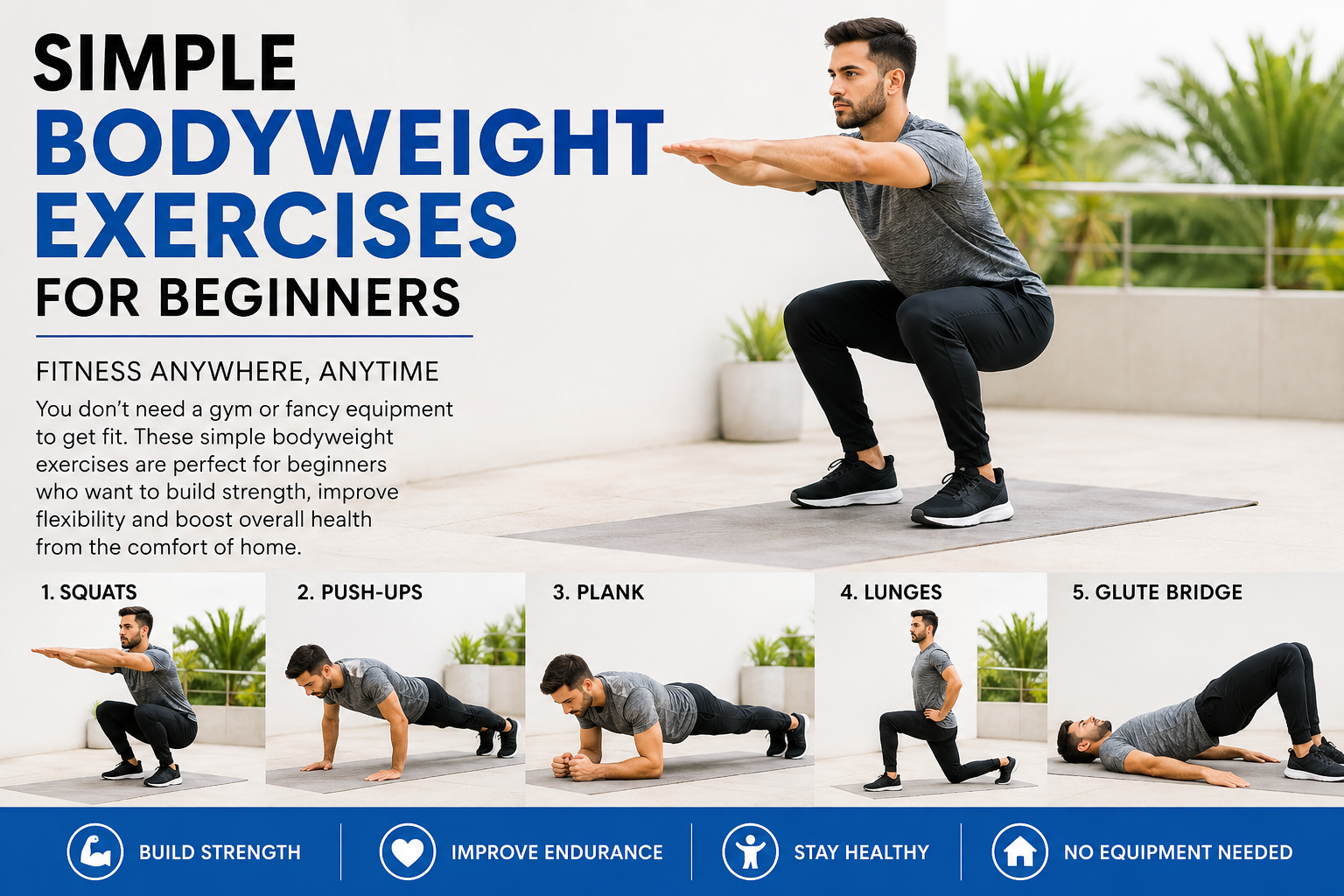
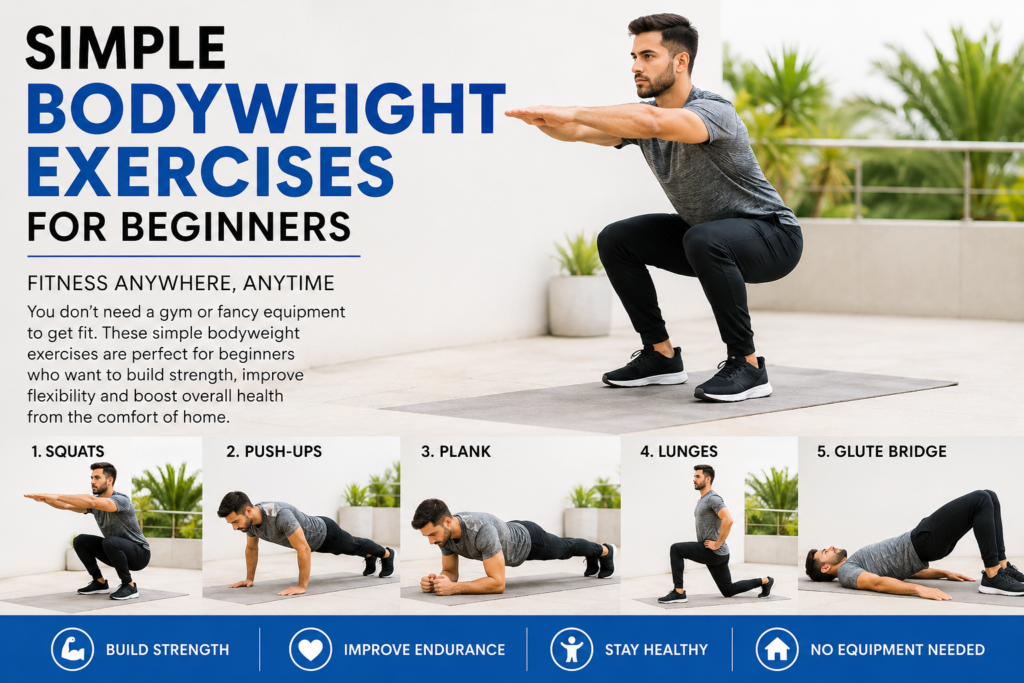
Common examples include squats, push ups, lunges, planks, glute bridges, and mountain climbers. These exercises can target different muscle groups and can be modified according to your fitness level.
One thing I really like about bodyweight training is its simplicity. You do not need to spend money on a gym membership before you begin. A small amount of open space and comfortable clothing can be enough for many beginner workouts.
Benefits of Bodyweight Exercises for Beginners
There are several reasons why bodyweight exercises are useful for people who are new to fitness.
Easy to Start
Most bodyweight exercises are simple to understand. Beginners can start with easier variations and gradually progress as they become stronger.
No Expensive Equipment
You can perform many bodyweight exercises without weights or machines. This makes them a practical choice for home workouts.
Builds Basic Strength
Exercises such as squats, push ups, and lunges work several muscles at the same time. They can help beginners develop the basic strength needed for more advanced training.
Improves Balance and Coordination
Bodyweight movements require you to control your body. Regular practice can improve balance, coordination, and movement awareness.
Convenient for Home Workouts
One of the biggest advantages is convenience. You can complete a short workout at home without traveling to a gym.
1. Bodyweight Squats
Bodyweight squats are one of the best beginner exercises because they work the legs, hips, and glutes.
To perform a squat, stand with your feet around shoulder width apart. Keep your chest comfortable and your back in a natural position. Slowly bend your knees and push your hips backward as if you are sitting on a chair. Lower yourself as far as you can comfortably control, then push through your feet to return to the starting position.
Beginners can start with 8 to 12 repetitions for two or three sets.
Focus on controlled movement rather than speed. If you cannot squat deeply while maintaining good form, use a comfortable range of motion and improve gradually.
2. Wall Push Ups
Traditional push ups can be challenging for beginners, so wall push ups are a useful starting point.
Stand facing a wall and place your hands against it around shoulder height. Take a small step backward. Keep your body relatively straight as you bend your elbows and bring your chest toward the wall. Push yourself back to the starting position.
This exercise works the chest, shoulders, arms, and core while placing less demand on your body than a regular push up.
As you become stronger, you can move from wall push ups to incline push ups and eventually regular push ups.
3. Modified Push Ups
If you are ready for something more challenging, modified push ups can help you build strength.
You can perform them with your knees on the floor while keeping your upper body controlled. Place your hands slightly wider than your shoulders and keep your body aligned from your knees to your head.
Lower your body slowly and push back up.
Start with 5 to 10 repetitions and focus on maintaining good technique. You do not need to force yourself to complete a large number of repetitions.
4. Reverse Lunges
Lunges are excellent for strengthening the legs and improving balance. For beginners, I prefer reverse lunges because stepping backward can feel easier to control.
Stand tall with your feet comfortable apart. Step one foot backward and slowly lower your body by bending both knees. Push through the front foot to return to the starting position. Repeat on the other side.
Start with 6 to 10 repetitions per leg.
If your balance is not very good yet, you can hold onto a stable surface for support.
5. Glute Bridges
Glute bridges are simple but effective for working the glutes and supporting muscles around the hips.
Lie on your back with your knees bent and your feet flat on the floor. Keep your arms beside your body. Press your feet into the floor and gently lift your hips. Squeeze your glutes at the top, then lower your hips slowly.
Try 10 to 15 repetitions.
I recommend moving slowly during this exercise. The goal is to feel your glutes working rather than simply lifting your hips as quickly as possible.
6. Standing Calf Raises
Standing calf raises are another easy bodyweight exercise that beginners can add to their routine.
Stand upright with your feet comfortable apart. Slowly raise your heels so you are standing on the balls of your feet. Pause briefly at the top and then lower your heels with control.
You can perform 12 to 15 repetitions.
If you need help with balance, place one hand on a wall or sturdy surface.
7. Plank
The plank is a popular exercise for strengthening the core. Beginners do not need to hold a plank for several minutes. Even a short, controlled hold can be useful.
Start on your forearms and toes. Keep your body in a straight and comfortable position. Tighten your stomach muscles gently and avoid letting your hips drop too low or rise too high.
Beginners can start with 10 to 20 seconds and repeat two or three times.
If a regular plank is too difficult, perform it with your knees on the floor.
8. Bird Dog
The bird dog is a beginner friendly movement that works the core while also challenging balance and coordination.
Start on your hands and knees. Slowly extend one arm forward and the opposite leg backward. Hold the position briefly, then return to the starting position and switch sides.
Try 6 to 10 repetitions on each side.
Keep the movement slow and controlled. Avoid swinging your arms or legs.
How to Create a Beginner Bodyweight Workout
You do not need a long workout to get started. A simple routine can take around 15 to 25 minutes.
Here is an example beginner bodyweight workout:
Bodyweight squats: 10 repetitions
Wall push ups: 10 repetitions
Reverse lunges: 8 repetitions per leg
Glute bridges: 12 repetitions
Bird dogs: 8 repetitions per side
Plank: 15 seconds
Rest between exercises whenever you need it. After completing the routine, take a short rest and repeat it once or twice depending on your fitness level.
If you are completely new to exercise, start with one round. Once your body becomes comfortable with the routine, you can gradually add another round.
How Often Should Beginners Do Bodyweight Exercises?
Consistency matters more than trying to exercise every day. For many beginners, two or three bodyweight workouts per week can be a practical starting point.
Give your muscles time to recover between strength focused sessions. On other days, you can stay active through walking, gentle stretching, or other activities you enjoy.
The important thing is to create a routine that you can maintain. A simple workout that you actually do regularly is more useful than a complicated program that you stop after a few days.
Tips for Getting Better Results
The first tip I would give any beginner is to focus on form. Performing an exercise correctly is more important than rushing through repetitions.
Start slowly and learn how each movement feels. As your strength improves, increase repetitions, add another set, or move to a more challenging variation.
Warm up before exercising. A few minutes of gentle movement can help prepare your body for the workout. After training, allow yourself time to cool down and recover.
You should also pay attention to sleep, hydration, and nutrition. Exercise is only one part of a healthy lifestyle.
Most importantly, do not compare your progress with someone else’s. Everyone starts at a different fitness level.
Common Beginner Mistakes
One common mistake is trying to do too much too soon. Beginners sometimes believe that a harder workout always produces better results. In reality, excessive training can make it harder to stay consistent.
Another mistake is ignoring technique. Fast repetitions with poor form can reduce the quality of the exercise and may increase the chance of discomfort or injury.
Skipping rest is another problem. Your body needs recovery time, especially when you are new to exercise.
Finally, do not expect dramatic results overnight. Building strength and improving fitness takes time. Small improvements repeated consistently can make a meaningful difference.
Final Thoughts
Simple bodyweight exercises are an excellent way for beginners to start becoming more active. You can train your legs, arms, chest, core, hips, and other muscle groups without needing complicated equipment.
In my opinion, the best beginner workout is one that feels manageable enough to continue. Start with exercises such as squats, wall push ups, reverse lunges, glute bridges, bird dogs, and planks. Focus on good form, take enough rest, and gradually increase the challenge as your fitness improves.
You do not have to become extremely fit in one week. The real goal is to build a healthy habit that can become part of your daily life. Start where you are, keep the routine simple, and give yourself time to improve.