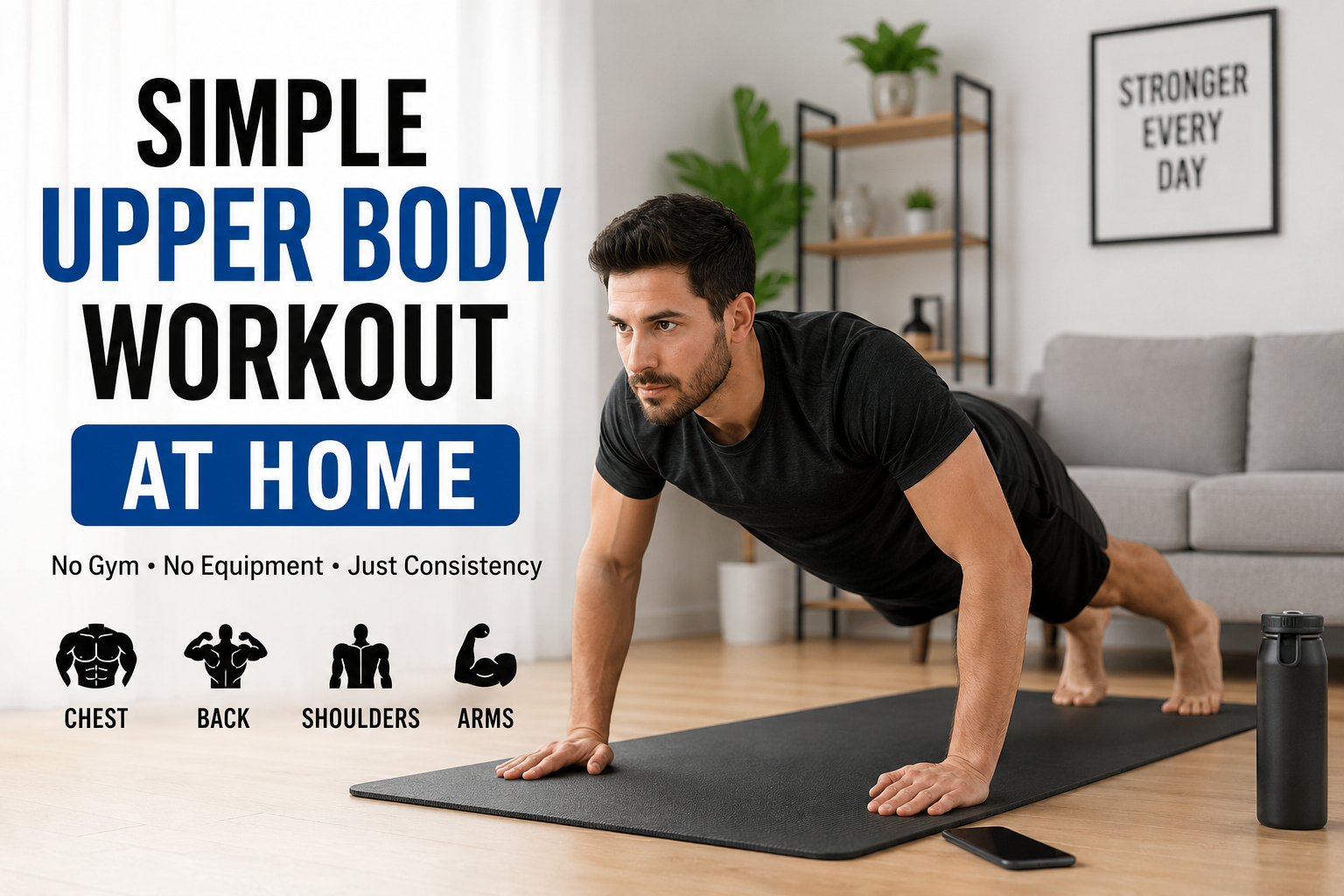
Staying active does not always mean joining a gym or buying expensive fitness equipment. I have found that some of the most useful workouts can be done right at home with very little space. If the goal is to build upper body strength, improve muscle tone, and become more active, a simple upper body workout at home can be a great place to start.
The upper body includes the chest, shoulders, back, arms, and core muscles that help support many everyday movements. With a few basic exercises and a consistent routine, you can train these muscles without needing complicated equipment.
In this guide, I will share a simple upper body workout at home that beginners can follow. I will also explain how to perform each exercise, how often to train, and how to make the workout more challenging as your strength improves.
Why I Like Upper Body Workouts at Home
One of the biggest advantages of exercising at home is convenience. I do not have to spend time traveling to a gym or wait for equipment. I can simply choose a comfortable space, warm up, and start my workout.
A home upper body workout can also be adjusted according to your fitness level. Beginners can start with fewer repetitions and longer rest periods. As strength improves, repetitions can gradually increase.
Another benefit is that bodyweight exercises can train several muscles at once. Push ups, for example, work the chest, shoulders, and triceps while also requiring the body to stay stable.
For me, consistency is more important than having a perfect workout setup. A simple routine that I can follow regularly is often more useful than an advanced workout that I rarely complete.
Warm Up Before Your Workout
Before starting any upper body workout, I recommend spending about five to ten minutes warming up. A warm up prepares your body for movement and helps you feel more comfortable during exercise.
You can start with arm circles, shoulder rolls, gentle arm swings, and light jogging in place. I also like to move my wrists and elbows gently before exercises that put pressure on the hands.
The warm up should feel easy. The goal is to prepare your muscles and joints rather than make yourself tired before the workout begins.
1. Push Ups
Push ups are one of the simplest and most effective upper body exercises that can be performed at home. They mainly work the chest, shoulders, and triceps while also engaging the core.
To perform a push up, place your hands on the floor slightly wider than your shoulders. Extend your legs behind you and keep your body in a straight line. Slowly lower your chest toward the floor while keeping your elbows controlled. Then push through your hands and return to the starting position.
If regular push ups feel difficult, beginners can perform them with their knees on the floor. Another option is to perform push ups against a sturdy wall or elevated surface.
I suggest starting with 2 to 3 sets of 6 to 12 repetitions, depending on your fitness level.
2. Incline Push Ups
Incline push ups are another excellent choice for beginners. They reduce some of the resistance compared with a standard push up, making the movement easier to control.
Place your hands on a stable elevated surface such as a sturdy table or countertop. Step your feet backward and keep your body straight. Lower your chest toward the surface and then push yourself back.
The higher the surface, the easier the exercise usually feels. As you become stronger, you can gradually use a lower surface.
Try 2 to 3 sets of 8 to 15 repetitions.
3. Pike Push Ups
Pike push ups are useful when you want to place more emphasis on the shoulders. They also challenge the arms and upper body.
Start in a position similar to a downward facing position with your hips raised. Keep your hands firmly on the floor and slowly bend your elbows to lower your head toward the floor. Then push back up.
This exercise can be challenging, so I recommend starting slowly. Focus on controlled movement rather than trying to complete a large number of repetitions.
Start with 2 sets of 5 to 10 repetitions.
4. Triceps Dips
Triceps dips can be performed using a stable chair or another sturdy surface. They primarily target the triceps at the back of the upper arms.
Sit near the edge of a sturdy chair and place your hands beside your hips. Carefully move your body forward while keeping your feet on the floor. Bend your elbows to lower your body slightly, then press through your hands to return to the starting position.
Always make sure the chair or surface is stable before performing this exercise. Avoid going too deep, especially if you feel discomfort in your shoulders.
Try 2 sets of 6 to 12 repetitions.
5. Superman Exercise
Although the upper body is often associated with the chest and arms, a strong back is equally important. The Superman exercise is a simple bodyweight movement that can help strengthen the muscles around the back and shoulders.
Lie face down on a comfortable surface. Extend your arms forward and your legs behind you. Slowly lift your arms and legs slightly from the floor while keeping your movement controlled. Hold briefly and then return to the starting position.
Do not try to lift as high as possible. A small controlled movement can be enough.
I usually recommend 2 to 3 sets of 8 to 12 repetitions.
6. Plank Shoulder Taps
Plank shoulder taps combine upper body strength with core stability. Start in a high plank position with your hands under your shoulders.
Lift one hand and gently touch the opposite shoulder. Place the hand back down and repeat on the other side. Try to keep your hips as stable as possible.
If this feels too difficult, you can widen your feet slightly for better balance.
Start with 2 sets of 10 to 20 total shoulder taps.
7. Arm Circles
Arm circles are simple but useful for adding movement to the shoulders. Stand upright with your feet comfortably apart and extend your arms to the sides.
Make small circles with your arms and gradually increase the circle size. After several repetitions, change direction.
This exercise is particularly useful during a warm up or as a light movement between harder exercises.
A Simple Home Workout Routine
If you are a beginner, you do not need to perform every exercise at maximum intensity. I prefer keeping the routine simple and focusing on good technique.
Here is an example routine:
Push ups: 2 to 3 sets of 6 to 12 repetitions
Incline push ups: 2 sets of 8 to 15 repetitions
Pike push ups: 2 sets of 5 to 10 repetitions
Triceps dips: 2 sets of 6 to 12 repetitions
Superman: 2 to 3 sets of 8 to 12 repetitions
Plank shoulder taps: 2 sets of 10 to 20 repetitions
Rest for about 30 to 90 seconds between sets depending on your fitness level.
You do not have to complete the entire routine in one session if you are new to exercise. Starting with a shorter workout and gradually building your endurance can make the routine easier to maintain.
How Often Should You Do an Upper Body Workout?
For most beginners, two or three upper body workouts per week can be a practical starting point. I like leaving recovery time between challenging sessions because muscles need time to recover.
You can combine your upper body workout with walking, lower body exercises, stretching, or other forms of physical activity on different days.
The important thing is not to believe that more exercise is always better. Recovery, sleep, nutrition, and consistency all play important roles in fitness.
How to Make Your Workout More Challenging
After several weeks, the same workout may start to feel easier. That is usually a good sign that your body is adapting.
Instead of immediately making the exercises much harder, I recommend making small changes. You can add a few repetitions, add another set, reduce rest time slightly, or use a more challenging variation.
For example, you might begin with incline push ups, move to knee push ups, and eventually progress to regular push ups.
If you have access to household items that are safe and suitable for exercise, you can also consider adding light resistance. However, bodyweight training alone can still provide a useful workout.
Common Mistakes to Avoid
One mistake I often see with home workouts is focusing too much on the number of repetitions. Performing twenty repetitions with poor technique is not necessarily better than performing ten controlled repetitions.
Another common mistake is skipping the warm up. Even a few minutes of gentle movement can help prepare you for exercise.
I also recommend avoiding sudden increases in workout intensity. Give your body time to adapt, especially if you have not exercised regularly.
Finally, listen to your body. Normal muscle effort can be expected during exercise, but sharp or unusual pain should not be ignored.
Stay Consistent
The biggest lesson I have learned about home workouts is that consistency matters. You do not need a large gym, expensive machines, or a complicated program to start becoming more active.
A simple upper body workout at home can be enough to create a regular exercise habit. Start at a level that feels manageable, learn proper exercise form, and gradually increase the challenge as your strength improves.
I also believe it helps to choose a specific time for exercise. When a workout becomes part of your daily or weekly routine, it is easier to stay committed.
Final Thoughts
A simple upper body workout at home can be a practical way to train your chest, shoulders, back, and arms without a gym membership. Exercises such as push ups, incline push ups, pike push ups, triceps dips, Superman exercises, and plank shoulder taps can create a balanced bodyweight routine.
My advice is to start slowly, focus on proper form, and give yourself enough recovery time. Fitness is not about doing everything perfectly from the first day. It is about making small improvements and continuing with them.
If you are new to exercise or have an injury or medical concern, consider speaking with a qualified healthcare or fitness professional before beginning a new workout program.
With patience and consistency, your home can become a simple and effective place to build upper body strength.