Starting a workout routine does not always mean joining a gym or buying expensive equipment. In my experience, some of the most useful beginner exercises can be done right at home using only your body weight. A beginner leg workout at home without weights is a simple way to start building strength, improving balance, and making your daily movements easier.
Your legs contain some of the largest muscles in your body, so training them can be an important part of a balanced fitness routine. The good thing is that you do not need dumbbells or machines to get started. With basic bodyweight exercises, enough space, and a little consistency, you can create an effective leg workout at home.
In this guide, I will share a simple beginner leg workout at home without weights that focuses on the major muscles of the legs. The exercises are easy to understand and can be adjusted according to your fitness level.
Why Try a Leg Workout at Home?
One of the biggest advantages of working out at home is convenience. You do not have to travel to a gym or wait for equipment. You can exercise in your bedroom, living room, or another safe area with enough space to move comfortably.
A home leg workout can also help beginners become more comfortable with exercise. Instead of starting with complicated movements, you can learn basic bodyweight exercises and gradually improve your technique.
Regular leg training may help support muscle strength, balance, coordination, and everyday movement. Stronger legs can make activities such as walking, climbing stairs, standing, and getting up from a chair feel easier.
How to Prepare for Your Beginner Leg Workout
Before starting your workout, spend a few minutes warming up. A warm up helps you prepare your body for movement and can make your workout feel more comfortable.
You can begin with easy movements such as walking in place, gentle knee lifts, ankle circles, and slow bodyweight squats.
I recommend starting slowly rather than trying to complete as many repetitions as possible. Your main goal as a beginner should be learning proper movement and building consistency.
Make sure you have enough space around you. Wear comfortable clothing and exercise on a stable surface where you are unlikely to slip.
1. Bodyweight Squats
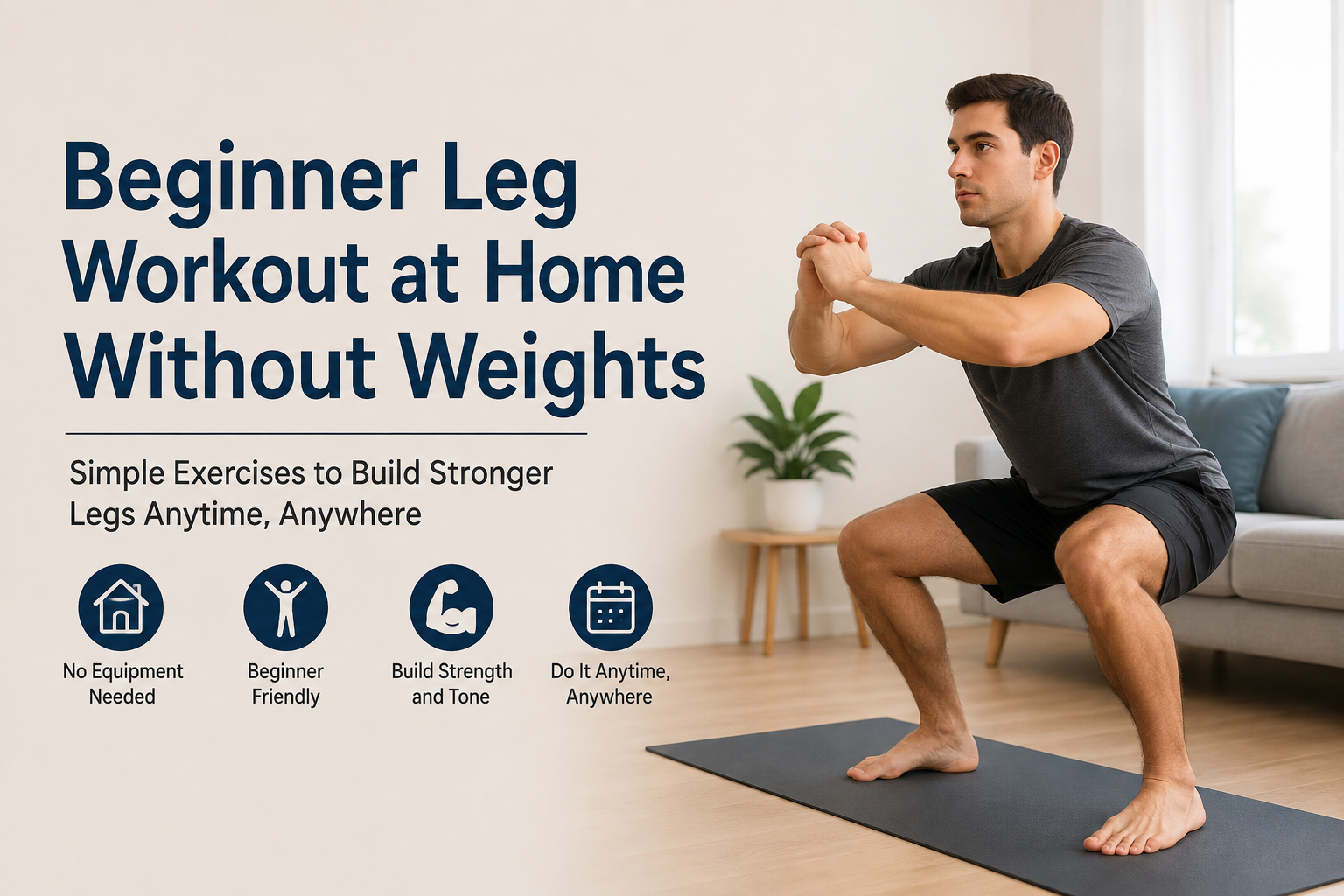
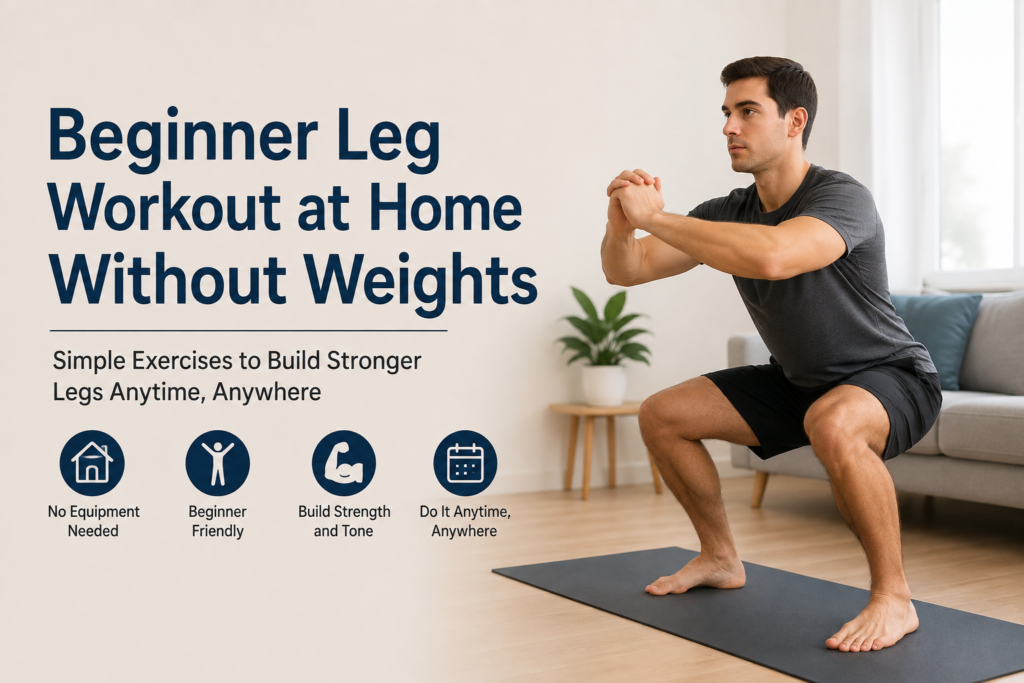
Bodyweight squats are one of my favorite exercises for a beginner leg workout at home. They are simple, require no equipment, and work several muscles at the same time.
Stand with your feet approximately shoulder width apart. Keep your chest comfortable and your back in a natural position. Slowly bend your knees and lower your hips as if you were going to sit on a chair.
Go only as low as you can comfortably control. Then press through your feet and return to the standing position.
Beginners can start with 8 to 12 repetitions for one or two sets. As your strength improves, you can gradually increase the number of repetitions.
The most important thing is not to rush. Controlled movement is more useful than simply trying to complete a large number of squats.
2. Reverse Lunges
Reverse lunges are another useful bodyweight leg exercise for beginners. I like this variation because stepping backward can feel easier to control than moving forward for some people.
Start by standing tall with your feet comfortably apart. Step one foot backward and slowly bend both knees. Lower your body while keeping your upper body controlled.
Push through the front foot and bring your back foot forward to return to the starting position. Repeat on the other side.
Try 6 to 10 repetitions on each leg when you are beginning.
If balancing is difficult, perform the movement next to a sturdy surface that you can use for light support. Focus on stability before increasing your repetitions.
3. Glute Bridges
Glute bridges are performed on the floor and are a great addition to a beginner leg workout at home without weights. They mainly target the glutes while also involving muscles around the hips and back of the legs.
Lie on your back with your knees bent and your feet flat on the floor. Keep your arms comfortably beside your body.
Press your feet into the floor and slowly lift your hips. Pause briefly at the top while keeping the movement controlled. Then lower your hips back toward the floor.
Start with 10 to 15 repetitions.
Try not to use momentum. A slow and controlled movement can help you become more aware of the muscles you are working.
4. Calf Raises
Calf raises are very simple and can be done almost anywhere. They focus on the calf muscles and can also help you practice balance.
Stand upright with your feet about hip width apart. Slowly raise your heels so that you are standing on the balls of your feet. Pause for a moment and then lower your heels back down.
Start with 12 to 15 repetitions.
If you need help with balance, stand near a wall or another stable surface. As you become more comfortable, you can perform the movement without holding onto anything.
5. Wall Sit
A wall sit is a simple exercise that can challenge your leg muscles without requiring weights.
Stand with your back against a wall. Slowly slide your back down while bending your knees. Find a position that feels challenging but still allows you to maintain control.
Hold the position for around 15 to 30 seconds when starting out. Rest and repeat once or twice.
You do not have to hold a deep position. Beginners can use a higher position and gradually increase the challenge over time.
6. Step Ups
If you have a safe, stable step or low platform available, step ups can be included in your home leg workout.
Place one foot on the step and carefully push through that foot to bring your other foot upward. Step back down with control and repeat on the other side.
Start with 6 to 10 repetitions per leg.
Safety is particularly important with step ups. Never use an unstable chair, slippery surface, or object that could move while you exercise.
A Simple Beginner Leg Workout Routine
If you are not sure how to organize these exercises, you can keep your first workout simple.
Start with bodyweight squats for 8 to 12 repetitions. Follow them with reverse lunges for 6 to 10 repetitions per side. Then perform glute bridges for 10 to 15 repetitions and calf raises for 12 to 15 repetitions.
Finish with a wall sit for 15 to 30 seconds.
Rest between exercises whenever you need to. Beginners do not need to train until complete exhaustion. The goal is to develop a routine that you can continue regularly.
How Often Should Beginners Train Legs?
There is no need to train your legs hard every day. Beginners can start with a few leg focused sessions each week and allow recovery time between challenging workouts.
Your muscles need time to recover and adapt. On days when your legs feel tired, you can focus on gentle movement, walking, stretching, or rest.
Consistency is more important than doing an extremely difficult workout once and then stopping for several weeks.
Common Mistakes to Avoid
One common mistake I see with beginner workouts is trying to progress too quickly. It can be tempting to copy advanced workouts from social media, but beginners usually benefit more from mastering basic movements first.
Another mistake is ignoring technique. If an exercise feels uncomfortable or you cannot control the movement, reduce the number of repetitions or make the exercise easier.
Do not compare your progress with someone else’s. Everyone starts from a different fitness level.
It is also important not to ignore pain. Normal muscle effort can feel challenging, but sharp or unusual pain is a reason to stop the exercise and seek appropriate professional advice if needed.
How to Make Your Home Leg Workout More Challenging
Once the basic exercises become easier, you can gradually increase the challenge. You might add a few repetitions, perform another set, slow down the movement, or increase the duration of exercises such as wall sits.
You can also experiment with variations of familiar exercises. For example, after becoming comfortable with regular squats, you may eventually try controlled squat variations.
Progress does not always mean doing more repetitions. Better balance, improved technique, greater control, and increased consistency are also meaningful signs of progress.
Benefits of Staying Consistent
A beginner leg workout at home without weights can become a useful part of a broader fitness routine. Regular exercise may support strength, mobility, balance, and general physical fitness.
I believe consistency is one of the most important parts of any workout plan. A simple routine that you actually follow is usually more practical than a complicated routine that you avoid.
You can start with a short workout and gradually build from there. Even when you have limited time, a few controlled exercises can help you maintain an active lifestyle.
Final Thoughts
A beginner leg workout at home without weights is a practical way to start exercising without needing a gym or expensive equipment. Bodyweight squats, reverse lunges, glute bridges, calf raises, wall sits, and step ups can provide a simple foundation for leg training.
My advice for beginners is to start with manageable repetitions, focus on proper technique, and give your body enough time to recover. You do not need to become extremely fit overnight. Small improvements made consistently can eventually become significant.
Choose exercises that you can perform safely, listen to your body, and increase the difficulty gradually. With patience and regular practice, your home workout can become a comfortable and effective part of your fitness routine.
If you have an injury, medical condition, or concerns about whether exercise is appropriate for you, consider speaking with a qualified healthcare or fitness professional before starting a new workout program.