Tracking your fitness progress at home is one of the simplest ways to stay motivated and understand whether your workout routine is actually working. In my experience, exercising without tracking anything can make progress feel invisible. You may be getting stronger or more active, but if you do not record your results, it can be difficult to notice the small improvements that happen over time.
The good thing is that you do not need expensive equipment or a personal trainer to track fitness progress. A notebook, smartphone, measuring tape, or simple fitness app can be enough. The important thing is to choose a few measurements that match your goals and record them consistently.
Why Tracking Fitness Progress Matters
When I think about fitness progress, I do not look only at body weight. Fitness is much bigger than a number on a scale. Your strength, endurance, flexibility, energy levels, workout consistency, and body measurements can all show improvement.
Tracking your progress gives you a clear picture of what is happening. It can also help you identify habits that are working well and habits that may need to change.
For example, if you can perform more push ups than you could a month ago, that is progress. If you can walk for thirty minutes without feeling as tired as before, that is also progress. Even completing your workouts more consistently is an achievement worth recording.
Start With Clear Fitness Goals
Before tracking anything, I recommend deciding what you want to achieve. Your tracking system will be much more useful when you have a clear goal.
Some people want to lose weight, while others want to build strength or improve their fitness level. You may also want to improve endurance, increase flexibility, become more active, or simply create a healthier routine.
Try to choose one or two main goals instead of trying to measure everything at once. A clear goal makes it easier to decide which fitness progress measurements are important for you.
For example, someone focused on strength may track repetitions and resistance. Someone focused on weight management may track body weight and waist measurements. Someone interested in endurance may track walking or running time and distance.
Keep a Simple Workout Journal
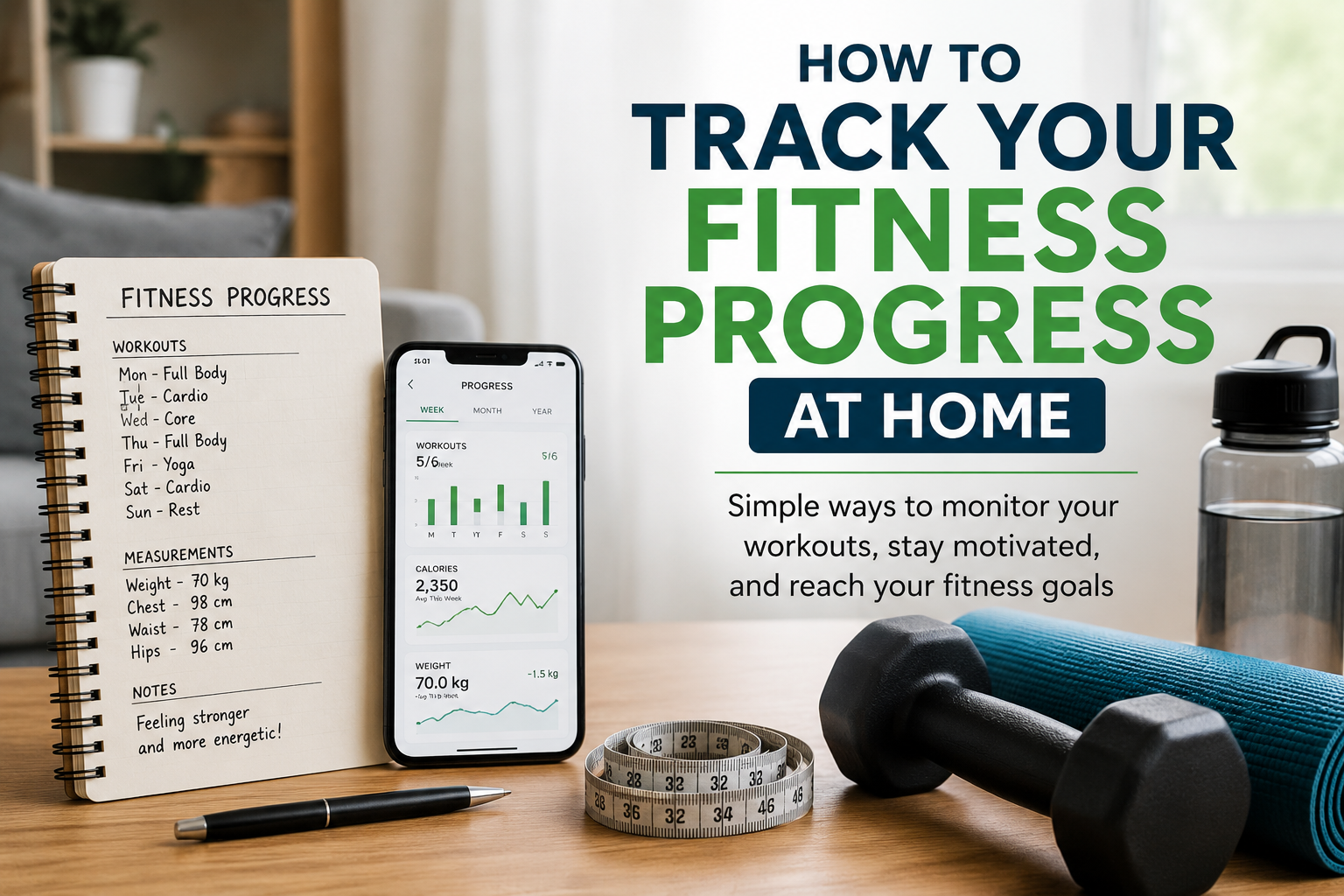
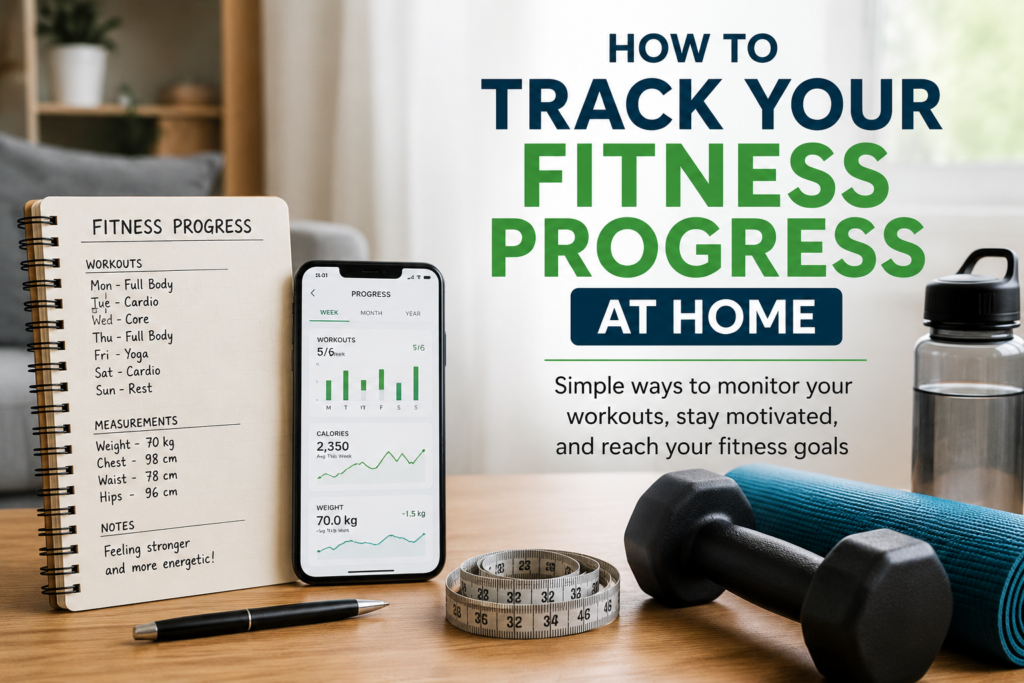
One of my favorite ways to track fitness progress at home is by keeping a workout journal. It does not need to be complicated. You can use a notebook or a notes app on your phone.
After each workout, write down what you did. Include the type of exercise, number of sets, repetitions, duration, and how difficult the workout felt.
For example, you might record that you completed three sets of ten squats, three sets of eight push ups, and a twenty minute walk.
After several weeks, you can look back and compare your results. You may discover that you are doing more repetitions, exercising for longer, or recovering more easily.
A workout journal also helps you stay consistent because you can see how often you are actually exercising.
Track Your Strength
Strength is one of the easiest areas to measure at home. You do not necessarily need heavy gym equipment.
Bodyweight exercises such as squats, push ups, lunges, planks, and glute bridges can provide useful progress measurements.
For example, if you could perform five push ups when you started and can now perform fifteen with good form, your strength has improved.
You can also track how long you can hold an exercise. If your plank time increases from twenty seconds to sixty seconds, that is a clear sign of improvement.
The key is to focus on proper technique. Performing more repetitions with poor form is not necessarily better. I prefer quality repetitions because they give me a more realistic idea of my fitness level.
Measure Your Endurance
Endurance is another important part of fitness progress. You can measure it through walking, jogging, cycling, dancing, or other cardiovascular activities.
At home, you can record how long you exercise and how you feel during the activity.
For example, you might start with a fifteen minute brisk walk. After a few weeks, you may be able to walk for thirty minutes at a similar pace without becoming as tired.
You can also record distance if you have a fitness tracker or smartphone that provides this information.
Improved endurance often appears gradually, so keeping records can help you notice changes that you might otherwise overlook.
Use Body Measurements Carefully
Body measurements can provide additional information, especially if your goal involves changing body composition.
A measuring tape can be used to track areas such as your waist, hips, chest, arms, or thighs. Take measurements under similar conditions each time so your comparisons are more meaningful.
I recommend measuring once every few weeks rather than checking every day. Daily changes can happen because of water, food, digestion, and other normal factors.
Remember that measurements are only one part of fitness progress. A person can become stronger and healthier without seeing dramatic changes in body measurements.
Do Not Depend Only on the Scale
Body weight can be useful, but I believe it should never be the only way to judge fitness progress.
Your weight can change from day to day for many normal reasons. Water retention, meals, hydration, and activity can all affect the number on the scale.
Instead of becoming focused on daily changes, look at longer term patterns. You can record your weight under similar conditions and compare the results over several weeks.
Also pay attention to other signs of progress. Your clothes may fit differently, your workouts may feel easier, or you may have more energy throughout the day.
These improvements can be just as meaningful as changes on the scale.
Take Progress Photos
Progress photos can be another useful tracking method. If you choose to take them, try to keep the conditions similar each time.
Use a similar location, lighting, distance, and clothing. You do not need to share these photos with anyone. They can simply be a private record for yourself.
Visual changes can be difficult to notice when you see yourself every day. Comparing photos after several weeks or months may help you recognize gradual changes.
The purpose should be to observe your journey rather than criticize your appearance.
Track How You Feel
Physical measurements are useful, but I also believe that your feelings matter.
After your workout, make a quick note about your energy, mood, sleep, and general experience. You might use simple words such as energetic, tired, comfortable, difficult, or strong.
Over time, you may notice interesting patterns. Perhaps you perform better after getting enough sleep. Maybe your energy improves when you exercise consistently.
This type of information can help you understand your body and make better decisions about your routine.
Use Technology to Make Tracking Easier
If you enjoy using technology, there are many simple ways to track fitness progress at home. A smartphone can record workouts, walking distance, exercise duration, and other useful information.
Some fitness apps can also display charts that make progress easier to understand.
However, I do not think technology is necessary. A simple notebook can work just as well if you use it consistently.
The best tracking system is the one you will actually continue using.
Review Your Progress Every Few Weeks
Recording information is helpful, but reviewing it is where you can learn the most.
Set aside a few minutes every two or four weeks to look at your records. Ask yourself what has improved and what still feels difficult.
You might discover that your strength has increased but your endurance needs more attention. Or you may realize that your biggest achievement has been becoming more consistent with exercise.
If something is not improving, do not immediately assume that you have failed. Your routine may simply need adjustment.
Avoid Comparing Yourself With Others
One mistake I would avoid is comparing your fitness progress with someone else’s.
Everyone starts from a different point. People have different schedules, experience levels, bodies, goals, and lifestyles.
Your most useful comparison is with your past self.
If you can do something today that was difficult several weeks ago, you are moving forward. Fitness should be a personal journey, and tracking gives you a way to see your own development.
Make Your Tracking Routine Easy
The simpler your system is, the more likely you are to continue using it.
You could record your workout immediately after finishing. You could take measurements once every few weeks. You could review your progress at the end of each month.
There is no need to spend a lot of time creating complicated spreadsheets unless you enjoy doing that.
For me, consistency matters more than complexity. A simple record that you maintain for six months is much more useful than a detailed system that you stop using after one week.
Final Thoughts
Learning how to track your fitness progress at home can make your fitness journey more organized and motivating. You can track strength, endurance, workouts, body measurements, progress photos, and even how you feel.
The most important thing is to choose measurements that match your personal fitness goals. Do not become obsessed with one number or expect dramatic changes every week. Real progress often happens gradually.
In my view, the best approach is to focus on consistency and look for small improvements. One extra repetition, a longer walk, better exercise form, or simply completing another week of workouts can all be signs that you are moving in the right direction.
With a notebook, smartphone, or basic measuring tape, you can create an effective fitness progress tracking system without leaving your home. Track your results honestly, review them regularly, and use what you learn to improve your routine. Over time, those small records can show you just how far you have come.